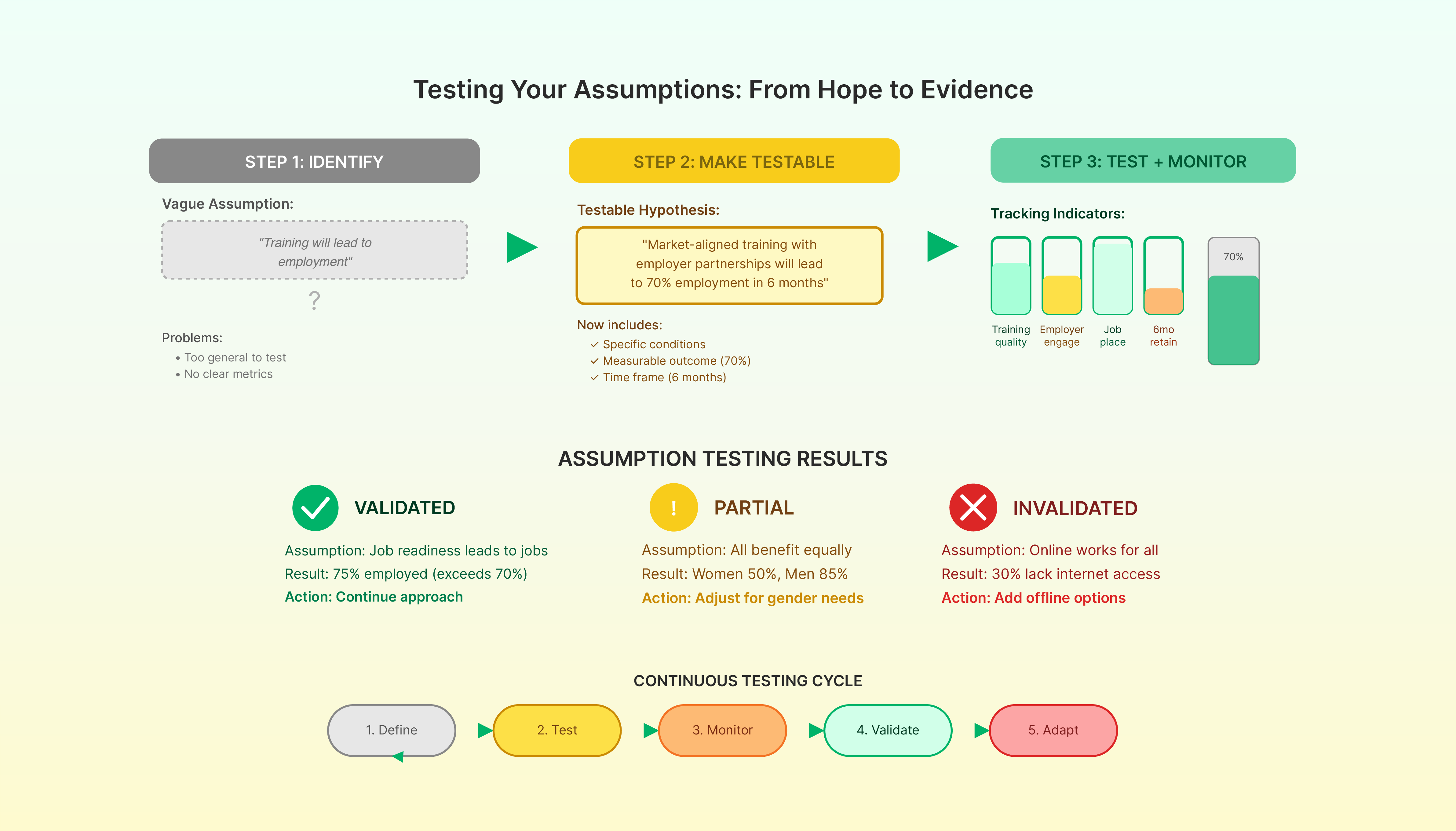
Every project has assumptions. The difference is whether you write them down.
I use this approach in my own project design work, and it helps teams stay aligned as the project evolves.
Assumptions are the conditions that must be true for your Theory of Change to work. If you do not name them, you cannot test them. That is a risk.
Here are common assumptions worth listing:
- The community will participate if invited
- Local leadership will allow program access
- The proposed activity fits the school or work calendar
- Key staff will remain in place during delivery
A simple way to capture assumptions is to add a small box next to each link in your Theory of Change:
- Activity -> Output: What must be true?
- Output -> Outcome: What must change in behavior?
- Outcome -> Impact: What must stay stable?
Then mark each assumption as one of three types:
- Testable now (you can validate in the next month)
- Testable later (requires time or data)
- Outside your control (needs a mitigation plan)
Try this: pick one assumption and list one way to test it. If you cannot test it, write a mitigation step instead. This keeps your plan realistic.
In Lesson 4 🎥, I walk through this inside the toolkit. Watch the lesson video to learn more.
Once you list assumptions, rank them by risk. High risk and low evidence assumptions should be tested first. This turns your ToC into a learning plan, not just a diagram. Keep a short assumptions log and review it monthly. If an assumption changes, update your activities or timeline.