What You’ll Be Able to Do with the Setup Your Project for Success Toolkit
Six concrete things your team can do after working through the Building Foundation module with one real project.
Written by
Abayomi Ogundipe
Founder
4 min read
Most project design resources are either:
Too abstract (concept notes full of jargon), or
Too tactical (checklists that don’t change how you think).
I built Setup Your Project for Success to sit in the middle: practical enough to use this month, but grounded enough to change how you design projects long term.
This blog is not a feature list. It’s a promise of what you’ll actually be able to do once you use the toolkit.
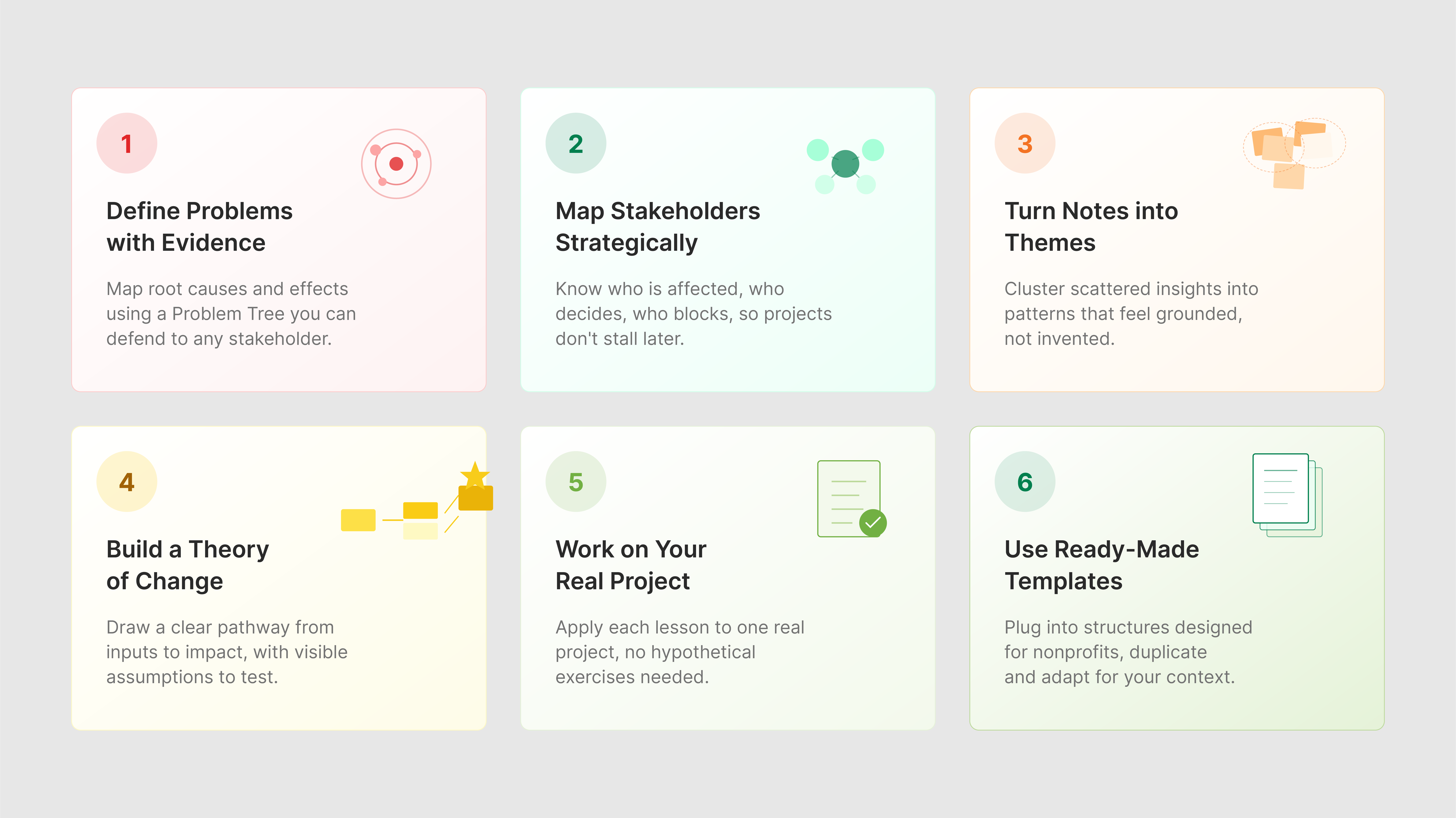
1. Define the Problem with Evidence
Instead of:
“Youth are unemployed.”
“Communities lack awareness.”
You’ll be able to:
Map root causes and effects using a Problem Tree.
Connect data, stories, and observations into a coherent picture.
Articulate a focused problem statement that you can defend in front of a donor, board, or community.
You’ll leave Lesson 1.1 with a draft problem tree you can refine with your team, not just a theoretical understanding of the tool.
2. Map Stakeholders So Projects Don’t Stall Later
Instead of listing partners as an afterthought, you’ll:
Identify who is affected, who decides, who pays, who blocks, and who carries risk.
Visualise relationships, influence, and interest.
Plan engagement strategies that go beyond “sensitization” and “meetings”.
Lesson 1.2 walks you through a stakeholder matrix, engagement protocols, and a simple way to spot risks early, so you’re not surprised in month six.
3. Turn Scattered Notes into Themes in a Day
If you’ve ever finished interviews or workshops with pages of notes and no idea what they mean, Lesson 1.3 is for you.
You’ll:
Capture key quotes, data points, and observations.
Cluster related ideas visually using an affinity board.
Name themes that feel grounded, not invented.
Translate those themes into design decisions.
This is how you move from “we heard a lot” to “we can see three clear patterns we need to design for.”
Surface assumptions that need to be tested, not hidden.
The goal is not a perfect diagram. It’s a working Theory of Change that you and your team can use to guide decisions, design indicators, and communicate with funders.
5. Work in Real Time on a Real Project
The toolkit is structured so you can apply each lesson to one real project:
A new idea you’re developing.
A program you want to redesign.
A proposal you need to strengthen.
You can follow it as a four-week sprint:
Week 1: Problem Tree + Stakeholders.
Week 2: Affinity + ToC.
Weeks 3 and 4: Refine, test with colleagues, adjust.
By the end, you don’t just have notes. You have a structured project design you can build on.
6. Use Templates and Visuals That Respect Your Time
Each lesson comes with:
A template you can duplicate and adapt.
Visual guides that show examples without overwhelming you.
Learn at your own pace, no timing or anything
You won’t need to invent your own structure; you’ll plug into one designed for nonprofits and social-impact teams.
Logical Framework. Map impact to goal and outcomes to purpose, with indicators and verification.
Activity Design. Expand Logframe lines into runnable tasks, owners, timing, and quality checks.
Proposal Writing. Write from your design so narratives and numbers stay aligned.
Budget Estimation. Build defensible costs from your activities with clear assumptions.
A Toolkit Built for the Future You’re Working Toward
Underneath all of this is a belief:
The future of sustainable development and education will depend on thousands of better designed projects, not just better slogans.
This toolkit is my contribution, a way to help you design one stronger project at a time.
On January 9, I’ll walk you through how to start. Between now and then, consider which project you want to bring to the table. That’s where the real value is.
Diagram
Inside the Toolkit - Capability Pathway
This flowchart shows how the Building Foundation lessons move one real project from raw inputs to clear capabilities, then points to the next module that operationalizes the Theory of Change.
graph TD
%% Inputs
A[Start with one real project: Setup your project for success]
T[Templates and time boxes]
%% Building Foundation module
subgraph BF[Building Foundation Module]
B1[Lesson 1.1 Problem Tree]
B2[Lesson 1.2 Stakeholder Mapping]
B3[Lesson 1.3 Affinity Diagram]
B4[Lesson 1.4 Theory of Change]
B1 --> B2 --> B3 --> B4
end
A --> B1
T --> B1
%% Capabilities from each lesson
B1 --> C1[Define the problem with evidence in 60 minutes]
B2 --> C2[Map stakeholders to avoid stalls]
B3 --> C3[Turn notes into themes in a day]
B4 --> C4[Build a working Theory of Change]
%% Cross cutting capabilities
BF --> C5[Work in real time on a real project]
T --> C6[Use templates and visuals that respect your time]
%% Next module preview
B4 -.-> D[Module 2: Operationalize the Theory of Change]
D --> D1[Logical Framework]
D1 --> D2[Activity Design]
D2 --> D3[Proposal Writing]
D3 --> D4[Budget Estimation]
D4 --> E[Outcome: Project donor and community support]