We’re heading into a decade where education, climate, inequality, and technology will collide in ways we can’t fully predict.
If you lead programs, write grants, or coordinate projects, you’re probably already feeling the pressure:
- Donors ask tougher questions.
- Communities expect deeper participation.
- Funders want both innovation and evidence.
- Your team is stretched, and planning often happens on the fly.
In that environment, a project without a strong foundation is fragile, no matter how inspiring the idea sounds in a pitch deck.
The Cost of Weak Foundations
Over the years, I’ve seen the same three patterns sink good intentions:
Vague problem statements:
“Youth are unemployed.”
“Girls are dropping out of school.”
“Communities lack awareness.”
These phrases describe symptoms, not structured problems. Without evidence and root-cause thinking, projects stay fuzzy. You end up trying to fix everything and solving nothing deeply.
Invisible stakeholders:
A proposal lists “community leaders” and “partners”, but nobody has mapped who actually holds power, who is trusted, who is marginalized, and who might block or champion change. Implementation then hits invisible walls.
Loose logic:
Activities and outcomes don’t connect. There’s no clear Theory of Change, no explicit assumptions, and no plan for how learning will influence decisions. Reports become a catalogue of activities instead of a story of change.
In a post-2030 world, where education, climate, and equity are under scrutiny, these weak foundations will be even more costly.
What a Strong Foundation Looks Like
A strong foundation doesn’t mean a 60-page logframe. It means you’ve done a small number of things deeply and well:
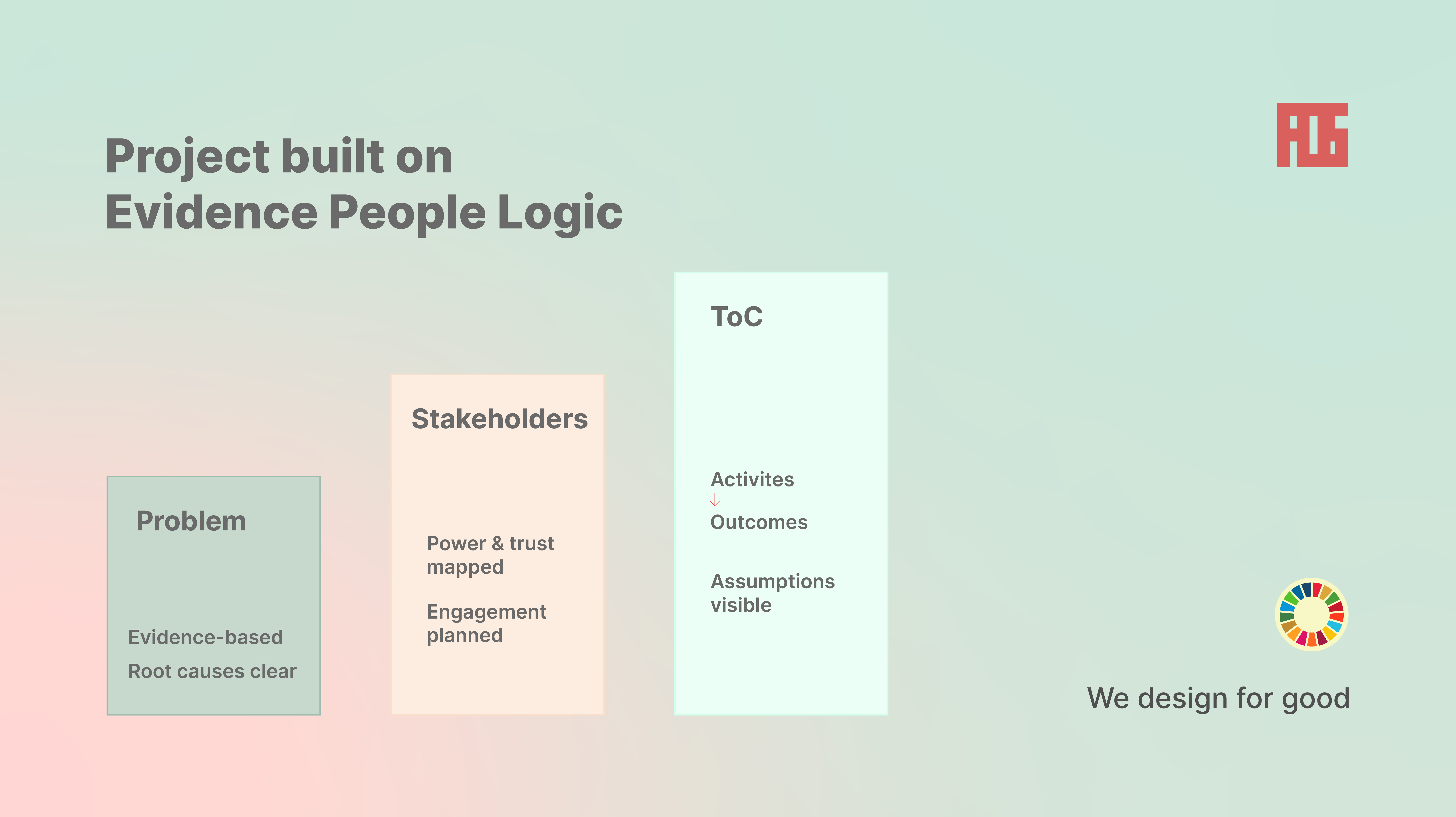
- You’ve framed the problem with evidence: You know the difference between a symptom and a root cause. You can show data, stories, and lived experience that justify your focus.
- You’ve mapped stakeholders and power: You know who is affected, who decides, who pays, who blocks, who carries risk, and whose voice is usually missing. You’ve thought about incentives and relationships, not just logos.
- You have a coherent Theory of Change: You can explain, in plain language, how your activities lead to outputs, outcomes, and impact, and what assumptions need to hold for that to be true.
- You treat learning as part of the work: You’re honest about uncertainty, you design for feedback loops, and you adjust instead of just reporting.
This is the kind of foundation donors increasingly expect, and communities deserve.
How the Setup Toolkit Helps You Build That Foundation
The Setup Your Project for Success toolkit is built around a simple idea:
If we help you get the foundations right, you can design stronger projects faster and with more confidence.
The toolkit runs eight lessons across two modules: (Module 1: Jan to Feb, Module 2: Mar to Apr).
The four Building Foundation lessons walk you through the core:
- Problem Tree Analysis: Turn a vague issue into a structured problem, with causes, effects, and evidence.
- Stakeholder Mapping and Engagement: See the full landscape, beneficiaries, partners, opponents, funders, and plan how you will work with them.
- Affinity Diagrams for Synthesis: Take interviews, surveys, notes, and field observations and turn them into clear themes and insights.
- Theory of Change: Connect it all into a logic chain that you can defend in a proposal, a team meeting, or a conversation with a community.
Then the four Operationalize the Theory of Change lessons turn strategy into execution:
- Logical Framework: Map impact to goal and outcomes to purpose, with indicators and means of verification.
- Activity Design: Expand Logframe lines into runnable tasks, owners, timing, and quality checks.
- Proposal Writing: Write from your design so narratives, outputs, and outcomes stay aligned.
- Budget Estimation: Build defensible costs from your activities with clear assumptions.
Each lesson is designed so you can apply it to a real project in 60 to 90 minutes. This is not theory on a slide; it’s structured work time.
Post-2030 Starts With Your Next Project
We don’t know exactly what the global framework after 2030 will look like. But we do know the direction:
- More emphasis on equity and inclusion.
- Higher expectations around evidence and accountability.
- Bigger integration between education, climate, digital, and social policy.
The best way to prepare is not to memorise every UN or donor process. It’s to strengthen the way you design projects now.
Start by asking:
- Is our problem statement grounded in evidence?
- Do we truly understand our stakeholders?
- Can we explain our Theory of Change clearly?
- Are we structured enough to learn and adapt?
If the honest answer is not yet, that’s exactly what this upcoming toolkit is for.
In January, I’ll walk you through these foundations step by step. For now, consider this an invitation to treat your next project as part of the post-2030 agenda, because it is.